Personal Projects / 2026
Get a Life
Designed and built a 3D life-simulation game where everyday choices become a race toward five goals: wealth, career, education, happiness and health.
Gameplay trailer · 90 seconds
A little city. A big life.
Explore the game
Welcome to Brightside
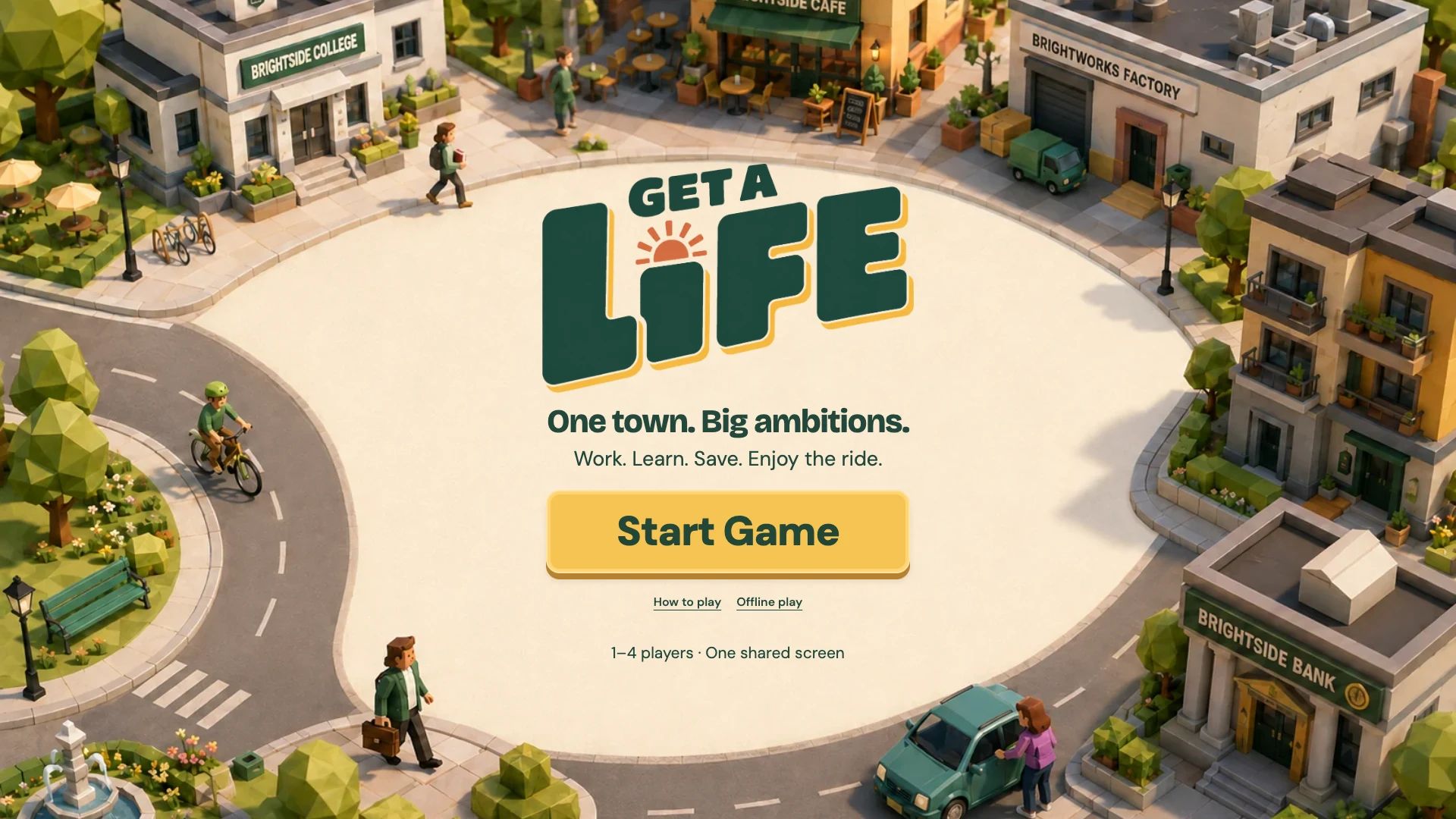
The title screen introduces the town, the game’s playful tone and the invitation to start a new life.
Find your look
Choose from 18 character looks before starting a new life in Brightside.
Challenge a rival
Choose a rival with their own personality and compete to complete all five goals.
Plan your next move
The overhead town map connects homes, workplaces, college, shops and leisure destinations.
Explore at street level
Walk through Brightside and choose how to spend the time available each week.
Take the wheel
Drive an owned car through Brightside.
Travel on two wheels
Ride a bicycle along the marked lanes through town.
Work becomes play
Build the right burger in a hands-on work mini-game.
Hard work pays
A completed job shift awards take-home pay with a burst of money confetti.
Train for the force
The Police Academy starts with a sprint and hurdles in Cadet Training.
Every career feels different
Drive patrol cars through a road grid to intercept escaping cars.
Find your timing
Position a pulse among moving nodes in the laboratory Chain Reaction mini-game.
Learn your way up
College courses have costs and prerequisites, connecting education to better jobs.
Build a little security
Move money into savings and make room for rent, daily costs and investments.
Make time to recharge
Rest at Humble Abode while balancing health, happiness and the weekly clock.
Expect the unexpected
The prowler ambushes the player, stealing cash during a real mugging encounter.
Choices have consequences
The ambulance arrives after a missed-meal week, turning a setback into an in-world sequence.
Five goals. One good life.
The trailer summary explains the five equally weighted goals: wealth, career, education, happiness and health.
Celebrate the whole journey
The fullscreen finale combines a 3D celebration with final progress across all five goals.
A small town with meaningful choices
Get a Life is an independent game I designed and built around a simple question: how will you build your good life? Players explore Brightside, take jobs, study, manage money and make time for themselves. The challenge is to reach all five life goals while balancing the limited hours in each week.
My work spans the game systems, interaction design, 3D world and interface, implementation, save handling and launch materials. The game supports solo play with a rival or a shared-screen match for up to four players.
Making a complex simulation approachable
A life simulation can quickly become a collection of disconnected meters and menus. I wanted each decision to feel concrete: taking a shift earns money but uses time; studying opens better jobs but costs tuition; resting helps you recover but competes with everything else you could do that week.
The design challenge was to keep those relationships understandable without flattening the game into a spreadsheet. Players needed a readable world, clear action costs and a consistent sense of progress.
Designing through a playable loop
I built the experience around a repeating loop: plan a week, move through town, choose an activity, see its consequences and compare progress. Street-level movement makes Brightside feel like a place, while the overhead map helps players find destinations and plan routes. Fullscreen interiors and focused activity menus connect the world to the decisions inside it.
I used AI-assisted development to move between design and implementation, then checked the result in the running game. Keeping the deterministic simulation separate from rendering lets the same rules support the 3D scenes, menus, rival turns and saved matches.
One connected life simulation
Work becomes a set of hands-on mini-games, including building burgers, directing police patrols and timing laboratory chain reactions. College courses connect education to career opportunities. Banking, investments, rent and everyday purchases make money a resource to manage rather than a score to collect.
Health and happiness give players reasons to eat, rest, exercise and make time for fun. A street prowler adds risk to carrying cash, while a missed-meal week leads to an ambulance journey and a hospital start. These consequences play out in the world as well as in the numbers.
The five goals remain visible throughout the match. Everyone receives equal turns before the winner is settled; extra progress across equally weighted goals breaks ties between finishers. The finale brings the characters together in a 3D celebration beside the final standings.
What the playable build delivers
The result is a playable local game with a connected town, work mini-games, progression, solo and shared-screen play, and persistent matches. Versioned saves, recovery checkpoints and export/import support continuity between sessions.
For the portfolio, I also built a 90-second Remotion trailer and a matching image set using real gameplay captures. Together they make the experience reviewable without requiring someone to learn the full game first. The captured moments show the core loop in action: character and rival selection, travel on foot and by vehicle, work and pay, police training, learning, recovery, street risks and a final comparison of progress.
What building it taught me
The most useful design work happened where systems met feedback: showing the cost before an action, making travel and setbacks visible, and giving every goal a clear place in the interface. A charming world helps invite people in; understandable rules and reliable saves help them stay oriented.
Building the launch trailer also became a useful clarity check. If a mechanic could not be explained with one short caption and a recognizable moment of gameplay, its presentation needed more thought.